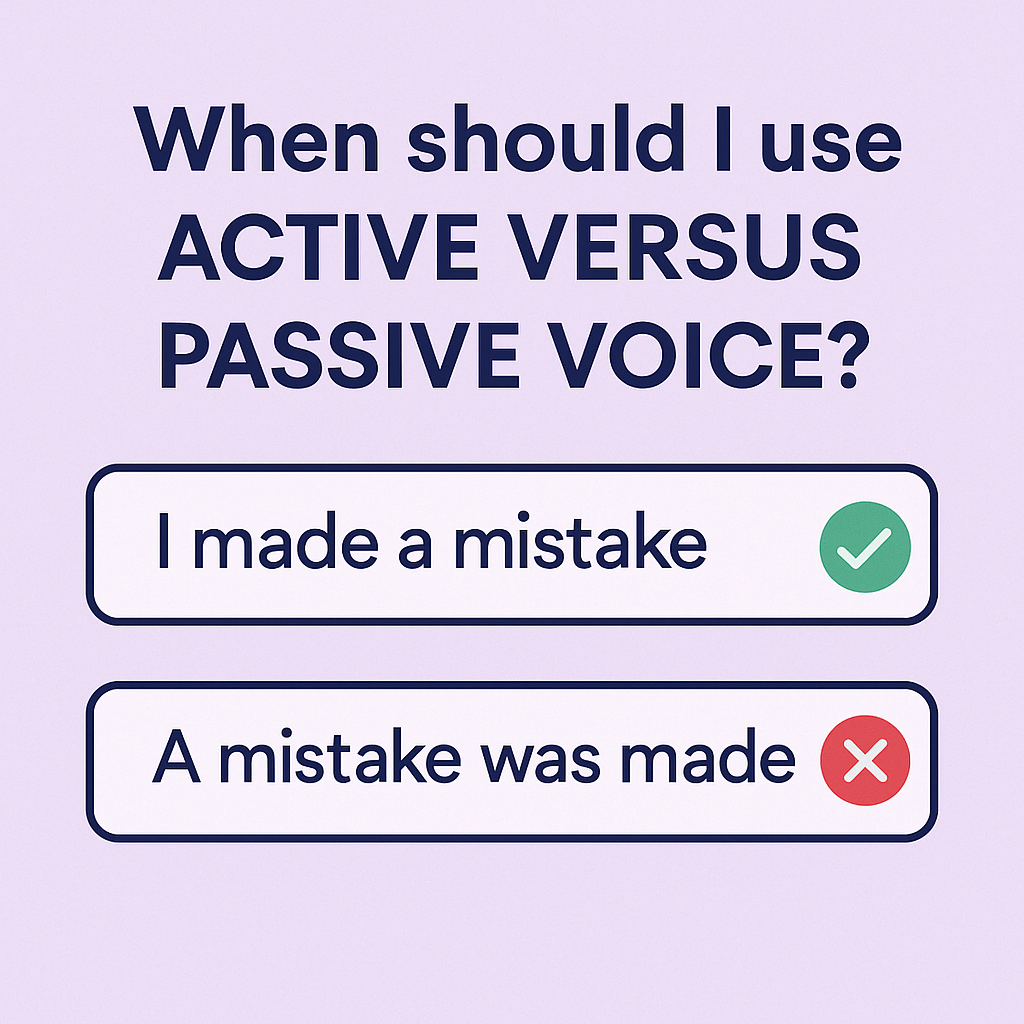
When Should I Use Active Versus Passive Voice?
Understanding voice in writing is essential. Voice shapes meaning. It affects clarity. Thus, it matters when to choose active or passive voice. The choice impacts how readers engage.
What Is Active Voice?
Active voice places the subject first. The subject performs the action. For example, “The cat chased the mouse.” Here, the cat does something. This creates directness. It often adds strength to writing.
What Is Passive Voice?
On the other hand, passive voice flips the focus. The subject receives the action. For example, “The mouse was chased by the cat.” Here, the mouse is not acting. This can create ambiguity. It may dilute impact. Thus, clarity may suffer.
When to Use Active Voice
Active voice works well in many scenarios. First, use it to create clarity. It allows readers to quickly grasp meaning. Consider writing instructions. When you say, “You complete the task,” it is clear.
Next, use active voice for engagement. It keeps readers interested. Instead of saying, “The book was read by her,” say, “She read the book.” This draws in readers. It makes them feel involved.
Also, active voice conveys urgency. When time is critical, say, “He must finish now.” It pushes action. This can lead to a quicker response. For more on writing clearly, check this link.
When to Use Passive Voice
Passive voice has its uses, too. First, it can emphasize the action. When the action is more important than the actor, passive voice fits. For instance, “The novel was published in 2020.” Here, the date matters more.
Next, consider anonymity. Sometimes, the actor is unknown or irrelevant. In such cases, passive voice works well. For example, “The window was broken.” Readers focus on the window, not the person who broke it.
Moreover, passive voice can create a formal tone. In academic writing, this may be necessary. It can help maintain objectivity. If you want to learn about formal writing, this link might help.
Key Differences
Active and passive voice affect meaning differently. Active voice creates scenes clearly. Passive voice can create distance. So, consider your message.
Use active voice for simple statements. Passive voice shines in complex or technical contexts. Think about the audience’s needs. Their understanding should come first.
Examples of Active and Passive Voice
To illustrate, consider the following examples:
Active Voice Examples
- The chef cooked dinner.
- The teacher explained the lesson.
- The dog bit the mailman.
Passive Voice Examples
- Dinner was cooked by the chef.
- The lesson was explained by the teacher.
- The mailman was bitten by the dog.
In each case, the active voice makes the sentence more dynamic. The subject performs the action directly. The passive voice makes it less so. It introduces a layer of separation.
How to Shift Between Voices
It’s easy to shift voices. Start with the subject. In active voice, place it at the beginning. Then, follow with the verb and the object.
For passive voice, begin with the object. Then, use a form of “to be” and the past participle. The agent, if needed, comes last. Consider this structure:
- Active: Subject + Verb + Object
- Passive: Object + form of “to be” + past participle + (by Subject)
Common Mistakes to Avoid
Many writers confuse the two voices. Here are some common pitfalls:
- Using passive voice too often. It may lead to unclear communication.
- Forgetting to identify the subject. This can weaken your writing.
- Neglecting your audience. Always consider what they need to know.
Practice Makes Perfect
Practice helps. Write examples in both voices. Then, compare clarity and impact. You will see the differences. Seek feedback to improve. You can read more about improving writing skills here.
Conclusion
In summary, both voices serve different purposes. Active voice creates immediacy and clarity. Passive voice offers emphasis and formality. Knowing when to use each voice enhances writing. Focus on your message and your audience. As you write, keep experimenting with both. This will improve your skills over time.
By understanding the nuances, you can become a better writer. Explore other aspects of writing by visiting the EditMojo blog.
This HTML article provides a comprehensive overview of active versus passive voice while maintaining a simple writing style, using transition words, and ensuring clarity. Internal and external links connect to relevant content for further exploration.
#active #passive #voice